The short answer is yes: air testing is accurate, and for understanding what you are actually inhaling in your home, it is the most direct measurement available. Air is the medium you breathe. Every other indoor testing method (dust, surfaces, bulk material) measures a proxy for what may have passed through your air at some point. Testing the air directly is not one option among many. It is the scientifically aligned approach to understanding what you are breathing.
The longer answer is that there are two distinct types of air quality tests for mold, and each one is accurate for the question it is designed to answer. Spore-based air testing has been the standard in the mold inspection industry for decades. It measures biological particles and helps determine whether mold is actively spreading through your indoor air. Mycotoxin-specific airborne testing is a newer methodology grounded in analytical chemistry. Both are legitimate methods and both are accurate for what they are built to measure.
Why Air Is the Right Medium to Test
Dust, surfaces, and bulk materials can offer clues, but air testing is the most direct way to assess what may actually be inhaled in the indoor environment.
Why Testing the Air Is the Most Direct Measure of Indoor Exposure
Before evaluating any specific type of air test, it helps to understand why air sampling is the foundational method for indoor exposure assessment, and why no other medium provides the same directness.
Air is what you breathe
Air is what you breathe, not a proxy for it. Dust and surface tests measure what has settled and accumulated over time, while air testing measures what is suspended right now in the space where you breathe.
Inhalation is the primary indoor exposure route
Research across occupational settings consistently confirms that mycotoxin exposure in indoor environments occurs predominantly through inhalation of contaminated airborne particles (Marcelloni et al., 2024). Surface contact and incidental ingestion of settled dust are secondary pathways. If the concern is what you and your family are breathing, the air is where the answer lives.
Breathing-zone placement captures real exposure
The breathing zone is the air immediately surrounding your nose and mouth, the air you actually inhale. Positioning a sampler at that height reflects how breathing-zone risk has been assessed in occupational hygiene science for decades, the same discipline that protects workers from airborne chemical hazards in industrial environments. A sample collected at floor level or from a settled surface does not represent what is entering the lungs of an adult or child moving through a room.
Air testing is the PRV standard
When mold remediation work is complete, air sampling is the established method for post-remediation verification (PRV), confirming that the work was successful. Spore-based air testing before and after remediation gives you a quantitative, comparable measure of whether spore levels have normalized, something surface inspection alone cannot confirm. Mycotoxin-specific air testing after remediation answers the chemical exposure question: not just whether visible mold is gone, but whether the airborne chemical compounds it produced have cleared from the breathing zone.
Direct detection reduces ambiguity
When you test the air and find something present, you know it was airborne at the time of sampling. There is no guesswork about whether settled contamination re-entered suspension, and no proxy measurement standing in for what you actually breathed.
That is why air sampling remains the most direct way to assess what may actually be inhaled in an indoor environment.

Mold Spores and Mycotoxins Are Not the Same Thing
This distinction is the most important thing to understand before evaluating any air mold test, and it is almost entirely absent from the consumer-facing conversation about mold testing.

Mold Spores
Mold spores are biological particles, the microscopic reproductive seeds that mold colonies release into the air. When mold grows on a surface in your home, it periodically sheds spores. Those spores travel through the air, land on other surfaces, and can establish new colonies if conditions allow. Spore-based air tests detect and count these particles. High indoor spore counts relative to outdoor levels are a sign of active mold growth somewhere in the space.

Mycotoxins
Mycotoxins are something else entirely. They are chemical compounds produced by the mold colony itself as a byproduct of its metabolism, under specific conditions of temperature, moisture, and substrate (Bennett & Klich, 2003). They are not spores. They are not alive. They are stable chemical toxins that can become attached to airborne particles of multiple sizes, including fine and ultrafine particles capable of reaching deep into the lungs, allowing them to remain suspended in the air long after the mold colony that produced them has stopped growing or been remediated. Because they are chemicals rather than biological particles, no spore count can detect them.
Spore levels and mycotoxin levels do not move in sync. A home can have high spore counts with no mycotoxins present, because the conditions required for toxin production may never have been met. A home can also have low spore counts and still have mycotoxins in the air, because the mold colony may be gone while the chemical compounds it produced persist on fine airborne particles long after (Ritacco 2026a). This is why the choice of test matters: spores and mycotoxins are separate things, and a test built to find one will not find the other.


The Two Types of Air Mold Test
Air sampling has been used in environmental and occupational exposure assessment for decades. The same fundamental principles used to evaluate airborne chemical hazards in workplaces are applied when evaluating indoor biological particles or mycotoxin-bearing aerosols. What differs between testing approaches is not the concept of sampling air itself, but the analytical target being measured. Some methods identify biological organisms such as mold spores, while others detect chemical compounds associated with microbial activity. Understanding which analytical target is being measured is essential when evaluating the accuracy and relevance of any air test.
All air mold tests share one thing: they sample the air. What distinguishes them is what they are designed to detect, and that difference determines everything about how accuracy should be evaluated.
Spore-Based Air Testing
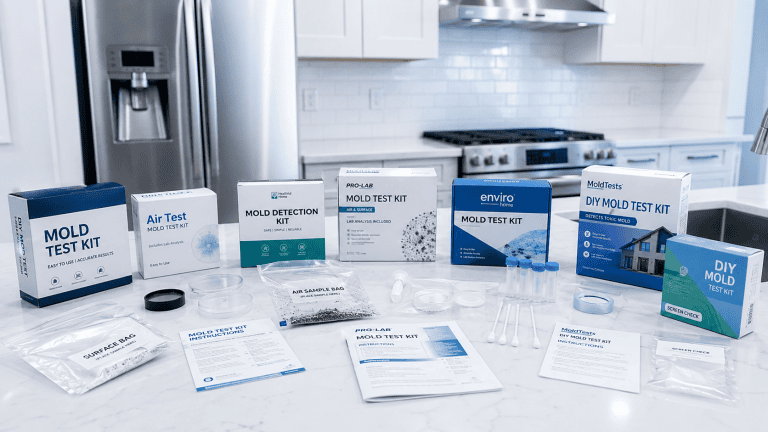
When most homeowners search for an air mold test, they find one of two things: a DIY settling plate kit from a hardware store, or a professional assessment using a spore trap device such as a Zefon Air-O-Cell or culturable sampling method.
All of these fall under spore-based air testing, but they do not work the same way.
Common types of spore-based air testing:
- DIY settling plate kits leave an open petri dish exposed to the air and wait to see what grows
- Professional spore trap sampling uses a calibrated pump to draw a known volume of air through a collection cassette, producing a quantitative measurement
- Culturable air sampling draws air onto a nutrient medium designed to support mold growth, then incubates the sample to identify viable spore types
All three approaches ask the same underlying question: what mold spores are present in this air sample at the time of collection?
Mycotoxin-Specific Airborne Testing
Mycotoxin-specific airborne testing is built on a different analytical target than spore-based air testing. Rather than identifying fungal organisms or counting spores, it is designed to detect the chemical compounds mold produces.
This method focuses on airborne mycotoxins, not biological particles.
How mycotoxin-specific airborne testing works:
- Air is sampled at breathing-zone height to reflect what occupants may actually inhale
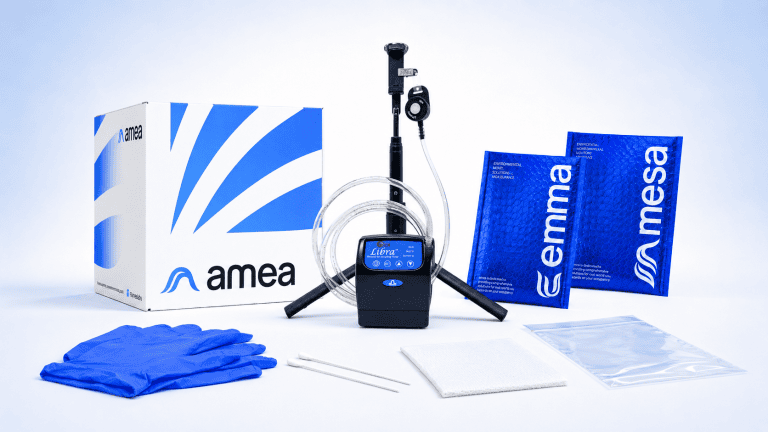
- A calibrated sampler collects airborne material from the indoor environment
- The collected sample is analyzed using analytical chemistry, not microscopy
- Methods such as ELISA are used to identify and quantify specific mycotoxin compounds
- Results are interpreted based on the presence of airborne toxins, not spore counts or visible growth
This approach asks a different question: are mycotoxin compounds present in the air being breathed in this indoor environment?

How Accurate Are Air Mold Tests? It Depends What You're Measuring
This is where the accuracy question gets meaningful, and where the two types of air test need to be evaluated separately rather than together.
The Accuracy of Spore-Based Testing
A professionally conducted spore trap test, performed with a calibrated pump, indoor and outdoor comparison samples, and proper laboratory analysis, is reasonably accurate at measuring mold spore concentrations at the time of sampling. That is a real measurement with real scientific validity. Professional spore trap testing substantially outperforms DIY alternatives: settling plate kits do not draw a known air volume, produce no quantitative spore count, include no outdoor baseline, and cannot reliably identify species. For spore measurement, methodology matters significantly.
The accuracy limitation of spore-based testing is not technical: it is about what the test is capable of detecting. Spore counts measure biological particles. They tell you whether mold is actively present and spreading in your indoor air. What they cannot tell you is whether mycotoxins are present, because mycotoxins are not spores. They are chemical compounds, and no spore count can detect them.
The Accuracy of Mycotoxin-Specific Airborne Testing
Mycotoxin-specific airborne testing uses established analytical chemistry to directly detect chemical compounds in the collected air sample, using the same detection methodology used in occupational exposure assessments across industrial and agricultural settings, with decades of validation behind it.
Because AMEA™ detects mycotoxins directly rather than inferring their possible presence from spore identification, it answers a fundamentally different question: what chemical compounds are currently suspended in the air at the height where you breathe? That is not a variation of the spore trap accuracy debate. It is a different instrument class measuring a different substance entirely. Assessing AMEA™ through the same lens as a spore trap misses the point, because the two methods are designed to answer different questions.
Spore Results Do Not Reflect Mycotoxins
As covered above, mycotoxins and spores behave independently. A spore trap taken after remediation may show clean results while mycotoxin-bearing particles remain airborne (Ritacco 2026a; Marcelloni et al., 2024). Direct airborne chemical detection is the best method currently available for capturing that reality
Which Air Test Is Right for Your Situation?
The right air test depends entirely on what question you are trying to answer.
A professionally conducted spore-based air test may be appropriate if you want to:
- Determine whether mold spore concentrations in your indoor air are elevated relative to outdoor baseline levels
- Confirm whether a known or suspected mold source is actively releasing spores into the living space
- Conduct post-remediation verification to confirm that spore levels have normalized following mold remediation work
A DIY settling plate kit is generally not appropriate for any of the above.
The absence of a calibrated air volume, outdoor comparison sample, species identification, and quantitative result make settling plate kits unsuitable for drawing any meaningful conclusion about your home’s air quality.
An airborne mycotoxin test like AMEA™ is the right choice if you want to:
- Understand whether mycotoxins are currently present in the air you are breathing
- Assess your chemical exposure in the context of health symptoms potentially related to mold
- Conduct post-remediation verification from a chemical standpoint, confirming not just that spores are gone, but that the airborne toxins associated with mold have cleared
- Answer the specific chemical exposure question that a functional medicine practitioner or environmental physician is asking (Ritacco 2026b; Ritacco 2026c)
These are not competing tests for the same question. They measure different things — and the framework for aligning each test with the right exposure question goes deeper on exactly that distinction. The most thorough environmental assessment of a home with suspected mold-related health concerns would include both: a professionally conducted spore test to characterize biological activity and an airborne mycotoxin test to characterize chemical exposure in the breathing zone. Neither substitutes for the other.
Not sure which mycotoxin test is right for your situation? See our full comparison guide: Which Mycotoxin Test at Home Should You Choose? You can also review the best mycotoxin test options for your home if you want a side-by-side breakdown.
| If you want to... | Best test |
|---|---|
| Determine whether indoor spore levels are elevated relative to outdoor baseline conditions | Professional spore-based air testing |
| Confirm whether a known or suspected mold source is actively releasing spores | Professional spore-based air testing |
| Conduct post-remediation verification to confirm that spore levels have normalized | Professional spore-based air testing |
| Find out whether mycotoxins are currently present in the air you are breathing | Airborne mycotoxin testing (AMEA™) |
| Assess potential chemical exposure in the context of mold-related health concerns | Airborne mycotoxin testing (AMEA™) |
| Conduct post-remediation verification from a chemical exposure standpoint | Airborne mycotoxin testing (AMEA™) |
| Use a DIY settling plate kit to draw a meaningful conclusion about indoor air quality | Not recommended |
What Air Mold Test Accuracy Really Depends On
Air testing is one of the most direct ways to evaluate what occupants may be inhaling in an indoor environment. The key is choosing the right type of air test for the question being asked, whether biological spores or chemical mycotoxins.
The accuracy debate you have encountered online belongs specifically to spore-based testing, and within that category, primarily to DIY settling plate kits rather than professionally conducted spore trap sampling. That debate is legitimate and worth understanding. What it should not do is cast doubt on air testing as a category, or on mycotoxin-specific airborne testing, which operates on different scientific principles, detects a fundamentally different substance, and is not subject to the same limitations.
Before choosing any air test, identify what you need to measure and the question you need to answer. Spore counts answer a biological question: is mold present and spreading? Mycotoxin levels answer a chemical one: are the toxic compounds produced by mold present in the air I breathe? Both questions matter. Both deserve the right instrument.
The question is not whether mold testing is worth doing. It is whether the test you choose can actually answer what you need to know. Respirare Labs’ AMEA™ Air Test Kit detects mycotoxins directly from your breathing zone, the chemical exposure question that spore counts cannot answer. It ships to your door and is designed for straightforward self-collection. Order your kit today or find a certified provider near you if you’d prefer a professional assessment.
FAQs About Air Mold Testing
DIY settling plate kits have significant limitations: they do not draw a known volume of air, include no outdoor comparison sample, and cannot reliably identify species. Professional spore trap testing with a calibrated pump and lab analysis is substantially more accurate. That said, both measure spores. Neither can detect mycotoxins.
A spore test captures and counts biological particles to assess mold activity in the air. A mycotoxin air test uses analytical chemistry to detect the chemical compounds mold produces, a fundamentally different substance that spore counts cannot identify. The two tests answer different questions and are not interchangeable.
For spore testing, a professionally conducted test with a calibrated pump and outdoor comparison is worth the investment. DIY kits are not, because their results cannot be meaningfully interpreted without those controls. For mycotoxin testing, the AMEA™ kit is worth pursuing when you need direct evidence of what chemical compounds are present in your breathing environment.
It depends on what you are testing for. For mold spore concentrations, a professionally conducted spore trap test is the most reliable approach. For mycotoxins, direct analytical chemistry methods like those used in AMEA testing are required. No spore-based test can detect chemical compounds regardless of how carefully it is performed. For a broader overview, see Environmental Mycotoxin Testing: What It Measures and Means.
Yes. DIY settling plate kits are widely available but cannot provide a quantitative result or outdoor comparison, making them difficult to interpret. Respirare Labs' AMEA™ Air Test Kit uses the same IOM sampler and methodology as professional mycotoxin assessments and is designed for straightforward self-collection. Not sure which test fits your situation? See Which Mycotoxin Test at Home Should You Choose?
References
- Ritacco, M. (2026a). Physicochemical Divergence of Mycotoxin and Biological Indicators Across Airborne, Dust Reservoir, and Surface Analytical Domains in Indoor Environments. Respirare Labs Preprint Archive.
- Ritacco, M. (2026b). An Exposure-Aligned Analytical Domain Framework for Interpreting Mycotoxin Measurements Across Airborne, Dust, and Surface Media in Indoor Environments. Respirare Labs Preprint Archive.
- Ritacco, M. (2026c). Operationalizing the Exposure-Aligned Analytical Domain Framework for Indoor Mycotoxins: Inhalation-Aligned Airborne Assessment in Indoor Environments. Respirare Labs Preprint Archive.
- Marcelloni, A. M., Pigini, D., Chiominto, A., Gioffrè, A., & Paba, E. (2024). Exposure to airborne mycotoxins: the riskiest working environments and tasks. Annals of Work Exposures and Health, 68(1), 19–35.
- Nazaroff, W. W. (2014). Indoor particle dynamics. Indoor Air, 24(3), 254–256.
- Bennett, J. W., & Klich, M. (2003). Mycotoxins. Clinical Microbiology Reviews, 16(3), 497–516.
- Morawska, L., & Nazaroff, W. W. (2013). The evolution of indoor particle research. Indoor Air, 23(6), 442–454.
- Hinds, W. C. (1999). Aerosol Technology: Properties, Behavior, and Measurement of Airborne Particles (2nd ed.). Wiley.
- American Conference of Governmental Industrial Hygienists. (2022). TLVs and BEIs.
- International Organization for Standardization. (1995). ISO 7708: Air quality — Particle size fraction definitions for health-related sampling.
- European Committee for Standardization. (1993/2019). EN 481: Workplace atmospheres — Size fraction definitions for measurement of airborne particles.