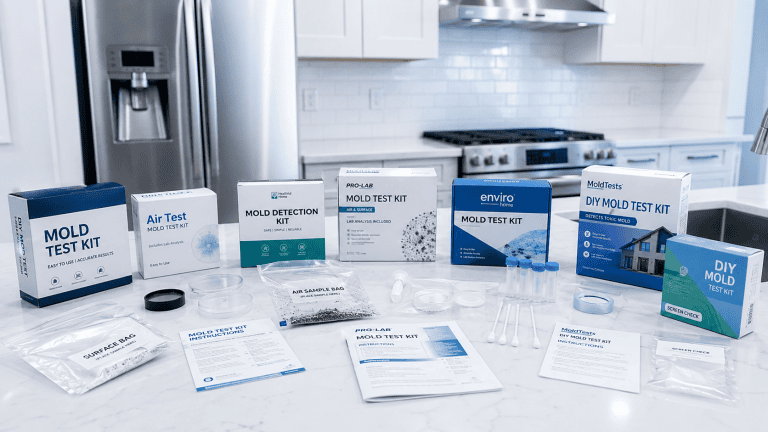
Where to get tested for mold exposure depends on what you are actually trying to evaluate. A healthcare provider can evaluate symptoms or medical concerns. A mold inspector or indoor environmental professional can evaluate visible mold, moisture, and building conditions. Environmental air, dust, or surface testing can evaluate whether selected mold-related contaminants are detectable in the sampled indoor environment, depending on the test method used.
That distinction matters because testing for mold and testing for mold exposure are not the same thing. Medical evaluation assesses the person. Mold inspection evaluates the building. Environmental testing evaluates the sampled indoor environment.
The right starting point depends on the question you need answered.
Key Takeaways
- Where you get tested for mold exposure depends entirely on what question you are trying to answer.
- Testing for mold and testing for mold exposure are not the same thing. A clean mold inspection does not confirm that mycotoxins are absent from the breathing zone.
- Presence does not equal exposure. Contamination somewhere in a home is not the same as contamination in the air you are breathing.
- Air, dust, and surface testing each evaluate different environmental domains and a result from one should not be used to draw conclusions about another.
- Medical testing evaluates the person and environmental testing evaluates the home. Neither is a substitute for the other.
Where to start depends on what you are trying to evaluate:
Health symptoms or medical concerns: Speak with a qualified healthcare provider. Medical evaluation can help assess symptoms, but it does not identify whether your home is the source of a concern.
Visible mold, moisture, or suspected growth in the home: A qualified mold or indoor environmental professional can inspect the building and evaluate moisture-related conditions.
Possible mycotoxins in your indoor environment: Air or surface testing can show whether selected mycotoxins are detectable in the specific area tested during the sampling period. Testing is available through an environmental professional or with an at-home collection kit.

Why the Type of Exposure You Are Evaluating Matters
The instinct to find a test is understandable. But choosing where to get tested before defining what you are testing for is where mold investigations most commonly go wrong.
Environmental testing is precise. But precision alone does not create clarity. A test that accurately measures the wrong thing does not resolve the investigation. It adds data and expense without answering the concern that prompted testing in the first place.
A test is only useful when it answers a clearly defined question.** Ritacco, 2026a
That means before choosing a testing method, a provider, or a lab, the question has to be defined.
In most mold investigations, the question is some version of one of these: Is mold growing somewhere in this home? Or are selected mycotoxins detectable in the air people are breathing here?
Those are different questions. They require different investigations, different tests, and different professionals.
Presence Does Not Equal Exposure
This is the most important concept in any mold-related investigation and the one most commonly overlooked.
Finding mold somewhere in your home does not confirm that you are being exposed to it. Finding mycotoxins in settled dust does not confirm that they are currently present in the air you are breathing. Presence and exposure are not the same thing.
Evaluating potential inhalation exposure requires sampling designed for the relevant air space, time period, and conditions of concern Ritacco, 2026a Bennett & Klich, 2003. Finding contamination somewhere in a building does not, by itself, establish what is present in a person's breathing zone.
This matters because many common testing approaches measure presence without measuring breathing-zone conditions. A result confirming that mold or mycotoxins exist somewhere in your home is accurate. But it does not answer the question most homeowners are actually asking: are selected mycotoxins detectable in the air I am breathing in this space?
That question requires a different kind of test in a different domain WHO, 2009.
Mold Inspection vs. Mycotoxin Exposure Testing
A standard mold inspection is performed by a mold inspector or industrial hygienist. The professional visits the home, evaluates moisture conditions and building materials, collects air or surface samples for spore analysis, and produces a report describing biological mold conditions. The result tells you whether mold organisms are present, at what levels relative to outdoor baselines, and what conditions may be contributing to growth. It does not evaluate whether mycotoxins are present in the breathing zone.
A mycotoxin exposure investigation takes a different approach. Rather than evaluating biological mold organisms, it collects air or surface samples specifically for chemical mycotoxin analysis. The result evaluates whether selected mycotoxins were detectable within the environmental domain that was sampled, such as breathing-zone air or a specific surface location. It does not identify visible mold sources or moisture conditions.
Both reports can be accurate. They are not interchangeable. A homeowner who receives a clean mold inspection report has not received confirmation that mycotoxins are absent from the breathing zone. A homeowner who receives a mycotoxin air test result has not received a building assessment or moisture evaluation. The professional, the method, and the report serve different purposes.
A standard mold inspection and a mycotoxin exposure investigation are not competing approaches. They are different investigations designed to answer different questions. Confusion starts when one type of test is used to answer the wrong question.
Not sure which testing path fits your situation? Take the Mold Testing Quiz to see whether your concern is better aligned with air testing, surface testing, a mold inspection, or medical evaluation.
Air, Surface, and Dust Testing: What Each Can Tell You
Once the question is clearly defined, the domain of testing follows directly from it.
Air answers exposure. Dust shows what has settled.
Air sampling evaluates what was captured from the breathing zone during the sampling period. Dust sampling evaluates what has accumulated over time. Surface sampling evaluates specific materials or locations. Each answers a different question. The most useful investigation begins by defining which question needs to be answered.
Air evaluates what is captured from the breathing-zone air during the sampling period. For homeowners concerned about whether selected mycotoxins may be present in the air of a specific indoor area, breathing-zone air sampling is the most direct environmental domain to evaluate that question. As one peer-reviewed study notes, the major advantage of sampling indoor air compared to other approaches is the additional information obtained on respiratory exposure Derz & Elsinghorst, 2025. Results should be interpreted within the location, timing, and sampling conditions used, because no single sample represents every condition throughout a home over time Ritacco, 2026a WHO, 2009.

Dust measures what has accumulated on surfaces over time. Settled dust carries a historical record of what has been present in a space, including contaminants that may have settled out of the air over days, weeks, or months. Because dust accumulates over time, it may contain contaminants that were present intermittently or at levels not captured during a single air-sampling event. This does not mean those contaminants are currently airborne. Dust helps describe accumulation. Air helps evaluate breathing-zone conditions during the sampling period. Dust testing can be useful for understanding historical accumulation and environmental burden; however, because cleaning removes the dust reservoir the test depends upon, dust testing becomes structurally limited as a post-cleaning verification tool Ritacco, 2026b.
Surfaces measure what remains on specific materials, contents, and areas of concern. Surface testing can evaluate residue on building materials after remediation or identify contamination on specific items. Like dust testing, surface testing evaluates a specific location rather than current breathing-zone air conditions.
The domain you test determines the question you can answer. For evaluating whether selected mycotoxins may be present in breathing-zone air specifically, air is the most directly relevant environmental domain. Dust and surface testing may provide important supporting information, but neither directly measures what is present in the breathing zone during the sampling period WHO, 2009 Ritacco, 2026a Al Hallak et al., 2023.
A common mistake is assuming that a non-detect air result automatically invalidates dust findings, or that a dust result automatically confirms current airborne exposure.** Neither conclusion is supported by the testing alone.
Air, dust, and surface measurements should be interpreted according to the question each was designed to answer.
Where to Get Tested: Your Options Explained
With the question defined and the relevant domain identified, the where becomes answerable. Here are the primary options, what each evaluates, and when each is appropriate.
Self collection at home
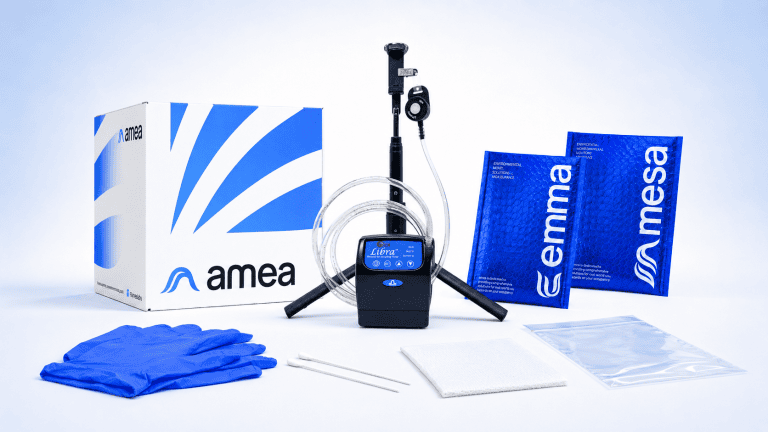
Respirare Labs' AMEA™ air test and MESA™ surface test are both available for self collection. The AMEA™ evaluates airborne mycotoxins captured from the breathing zone during the defined sampling period. The MESA™ evaluates mycotoxin residue on targeted surfaces and materials. Both can be ordered, performed by the homeowner, and returned for laboratory analysis without requiring a professional visit. Self collection is appropriate for homeowners who want to establish a baseline, check a specific area of concern, or verify conditions after remediation. Detailed sampling instructions are available at respirarelabs.com/how-to-test-for-mycotoxins-at-home.

Independent environmental professionals
Independent environmental professionals (IEPs) with training in exposure-aligned sampling can perform mycotoxin air and surface testing in your home. This is appropriate for complex investigations, cases where professional interpretation is needed alongside the results, or situations where legal or remediation documentation may be required. An experienced IEP can also help determine which environmental domain is most appropriate for the concern being evaluated and whether multiple domains should be assessed together. IEPs in the Respirare Labs provider network are available through our provider locator.
Medical evaluation through a healthcare provider
If you are experiencing symptoms you believe may be related to dampness, mold, or indoor environmental conditions, a qualified healthcare provider is the appropriate starting point for medical evaluation. Some providers may discuss laboratory testing for mycotoxins or related biomarkers; however, these tests should be interpreted cautiously. According to the CDC, there is no FDA-approved urine test for diagnosing illness from mycotoxin exposure, and mycotoxin levels that predict disease have not been established CDC, 2015. Medical evaluation also does not determine whether a specific home is the source of a concern. Environmental testing evaluates the home. Medical testing evaluates the person. Neither independently establishes cause-and-effect, but together they may provide useful information when interpreted within the broader investigation.
Standard mold inspectors
A standard mold inspection evaluates biological mold presence, moisture conditions, and building vulnerabilities. This is appropriate when the question is whether mold is growing in the home and where. Traditional inspections generally focus on moisture conditions and mold growth rather than mycotoxin air or surface sampling. If breathing-zone mycotoxin exposure is the specific concern, confirm whether a provider also offers mycotoxin-specific environmental testing. A standard mold inspection and a mycotoxin exposure investigation are not competing approaches. They are different investigations designed to answer different questions.
How to Know Which Test Is Right for Your Situation
The right test depends on the question you are actually trying to answer. Here is a direct decision framework:
You want to know whether selected mycotoxins are detectable in the air you are breathing
AMEA™ mycotoxin air test
Evaluates airborne mycotoxins captured from the breathing zone during the sampling period
You want to understand what has accumulated in the environment over time
Dust analysis
Provides a historical accumulation profile and may identify contaminants not captured during a single air-sampling event
You want to understand mycotoxin residue on surfaces or verify specific materials after remediation
MESA™ mycotoxin surface test
Measures mycotoxins remaining on surfaces and materials
You want a complete picture of breathing-zone mycotoxins and surface mycotoxin conditions
AMEA™ and MESA™ together
Both are mycotoxin-specific tests; air and surface answer different questions and provide complementary information
You want to understand mold growth, moisture conditions, and building vulnerabilities
Mold inspection
Evaluates biological mold conditions and contributing moisture sources
No single test answers every question. Air, dust, and surface testing each evaluate different environmental domains. A result from one domain should not automatically be used to draw conclusions about another domain. The most useful investigations begin by identifying the question first and then selecting the testing method designed to answer it.
If you are unsure which approach fits your situation, start by defining the question you are trying to answer. Are you trying to determine whether mold is growing in the building? Are you trying to evaluate whether selected mycotoxins may be present in the breathing zone? Are you trying to understand historical accumulation? Once the question is defined, the appropriate test often becomes much clearer.
For related reading on how different test types answer different questions, see How Accurate Are Air Mold Tests? It Depends What You're Testing For, Is Mold Alive? Yes. Mycotoxins Are Not., and What Kills Mycotoxins? Nothing, Actually.
Choosing the Right Next Step for Mold Exposure Testing
Where to get tested for mold exposure depends entirely on what you are trying to find out.
If your concern is whether mold is growing somewhere in your home, a mold inspection is the right starting point. If your concern is whether selected mycotoxins are detectable in the air you are breathing, you need a test that evaluates the breathing zone during the sampling period.
Those two investigations are related but they are not the same. Presence does not equal exposure. What exists somewhere in a building is not the same as what is present in the breathing zone of the people inside it. The test that answers one question is not automatically the test that answers the other.
Getting this right before testing begins saves time, money, and the frustration of accurate results that do not resolve the concern that prompted them.
If your main concern is the air you are breathing at home, AMEA™ mycotoxin air testing is designed to evaluate selected airborne mycotoxins captured from the breathing zone during the sampling period, through self collection or through an independent environmental professional near you.
See Our Home Testing Options
Explore Respirare Labs’ home environmental testing options for evaluating mold, mycotoxins, and related indoor contaminants across air, dust, and surface sample types.
Frequently Asked Questions
Where can I get tested for mold exposure?
Can a doctor test for mold exposure?
What kind of doctor tests for mold exposure?
Is there a test for mycotoxin exposure?
What is the difference between a mold test and a mold exposure test?
References
- Ritacco, M. (2026a). Physicochemical Divergence of Mycotoxin and Biological Indicators Across Airborne, Dust Reservoir, and Surface Analytical Domains in Indoor Environments. Respirare Labs Preprint Archive.
- Bennett, J. W., & Klich, M. (2003). Mycotoxins. Clinical Microbiology Reviews, 16(3), 497–516.
- World Health Organization. (2009). WHO guidelines for indoor air quality: Dampness and mould. WHO Regional Office for Europe.
- Derz, W., & Elsinghorst, P. W. (2025). From mold to mycotoxins: an LC–MS/MS method for quantifying airborne mycotoxins in indoor environments. Analytical and Bioanalytical Chemistry, 417, 4637–4648.
- Ritacco, M. (2026b). Masked and Modified Mycotoxins in Indoor Environments: Verification Logic for Post-Treatment Claims. Respirare Labs Preprint Archive.
- Al Hallak, M., Verdier, T., Bertron, A., Roques, C., & Bailly, J.-D. (2023). Fungal contamination of building materials and the aerosolization of particles and toxins in indoor air and their associated risks to health: A review. Toxins, 15(3), 175.
- Centers for Disease Control and Prevention. (2015). Notes from the field: Use of unvalidated urine mycotoxin tests for the clinical diagnosis of illness — United States, 2014. Morbidity and Mortality Weekly Report, 64(6), 157–158.